 by our College Data Analytics Team
We’ve pulled together the essential facts you should know about the program at Roosevelt University. You can study it at the Bachelor’s level. Jump to any of the following sections:
The table below lists every degree level available for clinical/medical laboratory science at Roosevelt University, along with how many graduates complete each level annually.Degree Level Annual Graduates Bachelor’s 8
During the most recent reporting year, Roosevelt University conferred 8 bachelor’s degrees in clinical/medical laboratory science.
Roosevelt University is not currently ranked for clinical/medical laboratory science at the bachelor’s level.
The full-time undergraduate tuition and fees are shown below.In State Out of State Tuition $31,493 $21,000 Fees $315 $315
Learn more about Roosevelt University tuition and fees.
Every one of the 8 students who graduated with a bachelor’s degree in clinical/medical laboratory science from Roosevelt University were women.
 The largest share of clinical/medical laboratory science bachelor’s degree graduates at Roosevelt University are Hispanic or Latino. Roughly 50% of graduates fell into this category.
The following table and chart show the ethnic background for students who recently graduated from Roosevelt University with a bachelor’s in clinical/medical laboratory science.
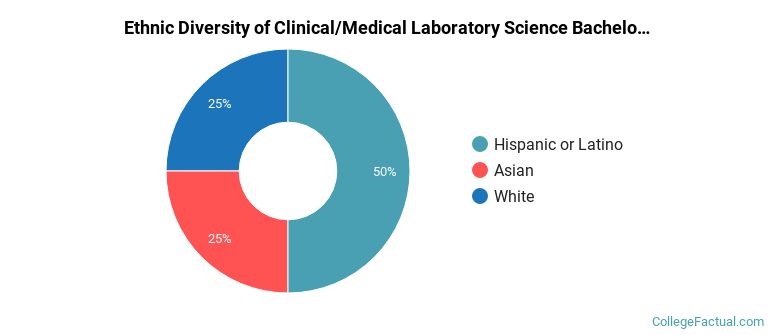
| Ethnic Background | Number of Students |
|---|---|
| Asian | 2 |
| Black or African American | 0 |
| Hispanic or Latino | 4 |
| White | 2 |
| Non-Resident Aliens | 0 |
| Other Races | 0 |
Roosevelt University awarded 5 bachelor’s degrees in clinical laboratory science/medical technology/technologist in the most recent reporting year — 100% to women and 0% to men. The largest share of these graduates were Hispanic or Latino (60%).
Roosevelt University awarded 3 bachelor’s degrees in histologic technology/histotechnologist in the most recent reporting year — 100% to women and 0% to men. Most of these graduates identified as Asian (33%).