 by our College Data Analytics Team
Explore the best ranked schools for the programs you are most interested in.
Bennett Career Institute was not ranked in College Factual's 2025 Best Overall Colleges report. This could be for a number of reasons, including lack of data.
If you are worried about getting into Bennett Career Institute, don't be. The school has a liberal open admissions policy, which means you only need to meet basic requirements in order to be admitted. Still, be sure to submit a complete application and provide any other requested materials.
At Bennett Career Institute, the student to faculty ratio is 20 to 1. Compared to the national average of 15 to 1, this is somewhat high. This could mean that class sizes may be larger than they are at other colleges or universities or that professors may be required to teach more classes.
The freshmen retention rate is a sign of how many full-time students like a college or university well enough to come back for their sophomore year. At Bennett Career Institute this rate is 60%, which is a bit lower than the national average of 68%.
During the 2017-2018 academic year, there were 267 undergraduates at Bennett Career Institute with 142 being full-time and 125 being part-time.
The net price is calculated by adding tuition, room, board and other costs and subtracting financial aid.Note that the net price is typically less than the published for a school. For more information on the sticker price of Bennett Career Institute, see our tuition and fees and room and board pages.
Almost 66% of college students who graduated with the class of 2018 took out student loans, but that percentage varies from school to school. At Bennett Career Institute, approximately 86% of students took out student loans averaging $3,863 a year. That adds up to $15,452 over four years for those students.
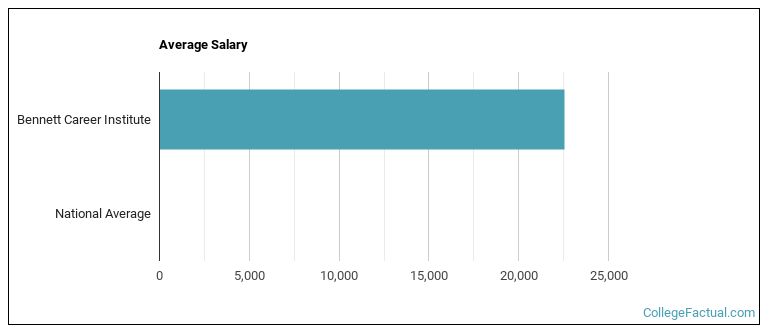
See which majors at Bennett Career Institute make the most money.
Get more details about the location of Bennett Career Institute.

Contact details for Bennett Career Institute are given below.
| Contact Details | |
|---|---|
| Address: | 700 Monroe Street N.E., Washington, DC 20017 |
| Phone: | 202-526-1400 |
| Website: | www.bennettcareerinstitute.org/ |
| Most Popular Majors | Bachelor’s Degrees | Average Salary of Graduates |
|---|---|---|
| Cosmetology | 74 | NA |
Online learning options are becoming more and more popular at American colleges and universities. Online classes are great for students who have busy schedules or for those who just want to study on their own time.
In 2022-2023, 201 students took at least one online class at Bennett Career Institute. This is a decrease from the 213 students who took online classes the previous year.
| Year | Took at Least One Online Class | Took All Classes Online |
|---|---|---|
| 2022-2023 | 201 | 0 |
| 2021-2022 | 213 | 0 |
| 2020-2021 | 267 | 0 |
| 2018-2019 | 0 | 0 |
Learn more about online learning at Bennett Career Institute.
Footnotes
*The racial-ethnic minorities count is calculated by taking the total number of students and subtracting white students, international students, and students whose race/ethnicity was unknown. This number is then divided by the total number of students at the school to obtain the racial-ethnic minorities percentage.
References
More about our data sources and methodologies.