 by our College Data Analytics Team
Explore the best ranked schools for the programs you are most interested in.
CALC was not ranked in College Factual's Best Overall Colleges report this year. This may be because not enough data was available.
If you are worried about getting into CALC Institute of Technology, don't be. The school has a liberal open admissions policy, which means you only need to meet basic requirements in order to be admitted. Still, be sure to submit a complete application and provide any other requested materials.
The student to faculty ratio at CALC is an impressive 8 to 1. That's quite good when you compare it to the national average of 15 to 1. This is a good sign that students at the school will have more opportunities for one-on-one interactions with their professors.
The freshmen retention rate is a measure of what percentage of first-year, full-time students come back for their sophomore year. The 25% rate at CALC Institute of Technology is a good bit lower than the national rate of 68%. This could be for a number of reasons, such as students transferring after a year because they changed majors.
During the 2017-2018 academic year, there were 99 undergraduates at CALC with 26 being full-time and 73 being part-time.
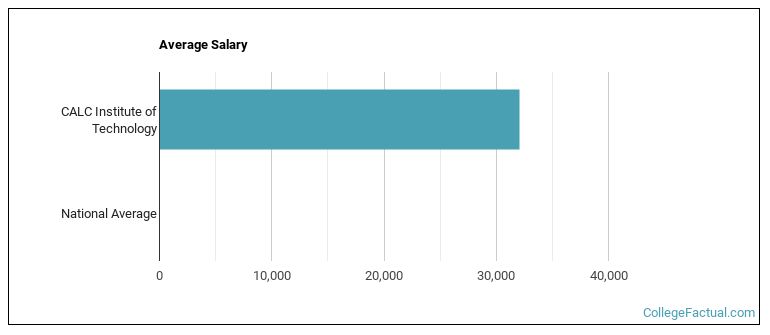
See which majors at CALC Institute of Technology make the most money.
Get more details about the location of CALC Institute of Technology.

Contact details for CALC are given below.
| Contact Details | |
|---|---|
| Address: | 200A North Center Dr, Alton, IL 62002 |
| Phone: | 618-474-0616 |
| Website: | calc.edu/ |
| Most Popular Majors | Bachelor’s Degrees | Average Salary of Graduates |
|---|---|---|
| Allied Health & Medical Assisting Services | 25 | NA |
| Practical Nursing & Nursing Assistants | 8 | NA |
| Computer Systems Networking | 4 | NA |
| Business Support & Assistant Services | 3 | NA |
| Health & Medical Administrative Services | 1 | NA |
Footnotes
*The racial-ethnic minorities count is calculated by taking the total number of students and subtracting white students, international students, and students whose race/ethnicity was unknown. This number is then divided by the total number of students at the school to obtain the racial-ethnic minorities percentage.
References
More about our data sources and methodologies.