 by our College Data Analytics Team
Explore the best ranked schools for the programs you are most interested in.
Cloyd's Beauty School 3 Inc was not ranked in College Factual's 2025 Best Overall Colleges report. This could be for a number of reasons, including lack of data.
If you are worried about getting into Cloyd's Beauty School 3 Inc, don't be. The school has a liberal open admissions policy, which means you only need to meet basic requirements in order to be admitted. Still, be sure to submit a complete application and provide any other requested materials.
At Cloyd's Beauty School 3 Inc, the student to faculty ratio is 20 to 1. Compared to the national average of 15 to 1, this is somewhat high. This could mean that class sizes may be larger than they are at other colleges or universities or that professors may be required to teach more classes.
The freshmen retention rate tells us what percentage of first-year, full-time students choose to continue on to their sophomore year at a particular school. The rate at Cloyd's Beauty School 3 Inc is 67%, which is about average when compared to the national rate of 68%.
During the 2017-2018 academic year, there were 75 full-time undergraduates at Cloyd's Beauty School 3 Inc.
The net price is calculated by adding tuition, room, board and other costs and subtracting financial aid.Note that the net price is typically less than the published for a school. For more information on the sticker price of Cloyd's Beauty School 3 Inc, see our tuition and fees and room and board pages.
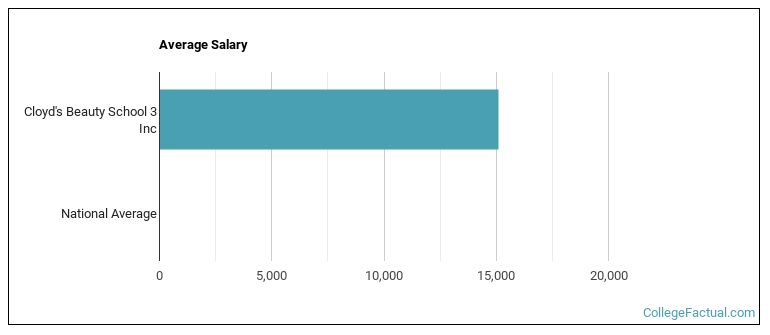
See which majors at Cloyd’s Beauty School 3 Inc make the most money.
Get more details about the location of Cloyd’s Beauty School 3 Inc.

Contact details for Cloyd's Beauty School 3 Inc are given below.
| Contact Details | |
|---|---|
| Address: | 2514 Ferrand St, Monroe, LA 71201 |
| Phone: | 318-376-9133 |
| Website: | https://cloydsbeautyschools.edu/ |
| Most Popular Majors | Bachelor’s Degrees | Average Salary of Graduates |
|---|---|---|
| Cosmetology | 47 | NA |
Footnotes
*The racial-ethnic minorities count is calculated by taking the total number of students and subtracting white students, international students, and students whose race/ethnicity was unknown. This number is then divided by the total number of students at the school to obtain the racial-ethnic minorities percentage.
References
More about our data sources and methodologies.