 by our College Data Analytics Team
Explore the best ranked schools for the programs you are most interested in.
Florida School of Massage was not ranked in College Factual's Best Overall Colleges report this year. This may be because not enough data was available.
As long as you meet basic requirements, you should not have any trouble getting into Florida School of Massage since the school has an open admissions policy. Still, be sure to submit any requested materials and that your application is completed in full.
The student to faculty ratio is often used to measure the number of teaching resources that a college or university offers its students. The national average for this metric is 15 to 1, but at Florida School of Massage it is much better at 8 to 1. That's good news for students who want to interact more on a personal level with their teachers.
The net price is calculated by adding tuition, room, board and other costs and subtracting financial aid.Note that the net price is typically less than the published for a school. For more information on the sticker price of Florida School of Massage, see our tuition and fees and room and board pages.
While almost two-thirds of students nationwide take out loans to pay for college, the percentage may be quite different for the school you plan on attending. At Florida School of Massage, approximately 36% of students took out student loans averaging $6,178 a year. That adds up to $24,712 over four years for those students.
Get more details about paying for Florida School of Massage.
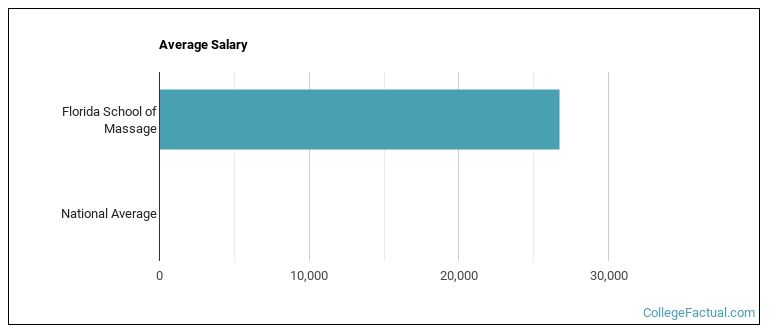
See which majors at Florida School of Massage make the most money.
Get more details about the location of Florida School of Massage.

Contact details for Florida School of Massage are given below.
| Contact Details | |
|---|---|
| Address: | 6421 Sw 13Th St, Gainesville, FL 32608-5419 |
| Phone: | 352-378-7891 |
| Website: | floridaschoolofmassage.com/ |
| Most Popular Majors | Bachelor’s Degrees | Average Salary of Graduates |
|---|---|---|
| Somatic Bodywork & Therapeutic Services | 72 | NA |
Footnotes
*The racial-ethnic minorities count is calculated by taking the total number of students and subtracting white students, international students, and students whose race/ethnicity was unknown. This number is then divided by the total number of students at the school to obtain the racial-ethnic minorities percentage.
References
More about our data sources and methodologies.