 by our College Data Analytics Team
Explore the best ranked schools for the programs you are most interested in.
Florida School of Traditional Midwifery was not ranked in College Factual's Best Overall Colleges report this year. This may be because not enough data was available.
See all of the rankings for Florida School of Traditional Midwifery.
Since Florida School of Traditional Midwifery has an open admissions policy, being accepted to the school isn't that hard. However, a full basic things - such as a high school diploma or equivalent - may be required. Also, go over your application to make sure it is complete before you submit it.
At Florida School of Traditional Midwifery, the student to faculty ratio is an excellent 6 to 1. That's much better than the national average of 15 to 1. This indicates that many classes will probably be small, and students will have ample opportunites to work closely with their professors and classmates.
During the 2017-2018 academic year, there were 60 full-time undergraduates at Florida School of Traditional Midwifery.
The student loan default rate at Florida School of Traditional Midwifery is 1.0%. This is significantly lower than the national default rate of 10.1%, which is a good sign that you'll be able to pay back your student loans.
Get more details about paying for Florida School of Traditional Midwifery.
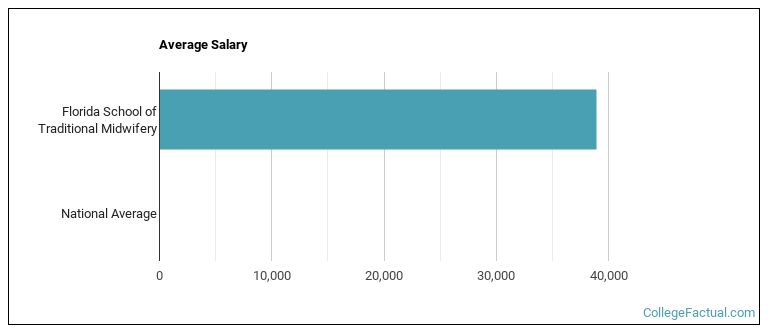
See which majors at Florida School of Traditional Midwifery make the most money.
Get more details about the location of Florida School of Traditional Midwifery.

Contact details for Florida School of Traditional Midwifery are given below.
| Contact Details | |
|---|---|
| Address: | 810 E University Ave, Gainesville, FL 32601 |
| Phone: | 352-338-0766 |
| Website: | midwiferyschool.org/ |
| Most Popular Majors | Bachelor’s Degrees | Average Salary of Graduates |
|---|---|---|
| Alternative Medical Support Services | 13 | NA |
This is a decrease from the 66 students who took online classes the previous year.
Learn more about online learning at Florida School of Traditional Midwifery.
Footnotes
*The racial-ethnic minorities count is calculated by taking the total number of students and subtracting white students, international students, and students whose race/ethnicity was unknown. This number is then divided by the total number of students at the school to obtain the racial-ethnic minorities percentage.
References
More about our data sources and methodologies.