College Factual  by our College Data Analytics Team
       Unbiased Factual Guarantee

New England Law - Boston Data & Information Overview

Want the scoop on New England Law - Boston? We’ve put together a comprehensive report on the school that covers what majors New England Law offers, how the school ranks, how diverse it is, and much more. If you’re interested in learning more about a particular stat, just click on its tile to go to a new page that covers the topic more in-depth. Also, you can jump to any section of this page by clicking one of the links below.

How Well Is New England Law - Boston Ranked?

2025 Rankings

Explore Best Ranked Schools for You

Explore the best ranked schools for the programs you are most interested in.

Overall Quality

New England Law was not ranked in College Factual's Best Overall Colleges report this year. This may be because not enough data was available.

See all of the rankings for New England Law - Boston.

Is It Hard to Get Into New England Law?

Learn more about New England Law - Boston admissions.

New England Law - Boston Faculty

19% Full Time Teachers

Student to Faculty Ratio

Data for the student to faculty ratio for this school has not been reported.

Percent of Full-Time Faculty

In addition to the student to faculty ratio, some people look at what percentage of faculty members are full-time as a sign of how much time professors will be able to spend with their students. This is because part-time teachers may not be be on campus as much as their full-time counterparts.

The full-time faculty percentage at New England Law - Boston is 19%. This is lower than the national average of 47%.

Full-Time Faculty Percent  19 out of 100
0
100

Retention and Graduation Rates at New England Law - Boston

Find out more about the retention and graduation rates at New England Law - Boston.

How Much Does New England Law - Boston Cost?

Get more details about paying for New England Law - Boston.

How Much Money Do New England Law Graduates Make?

Average Earnings Boost

Location of New England Law - Boston

Massachusetts State
Large City Campus Setting
Private Public/Private
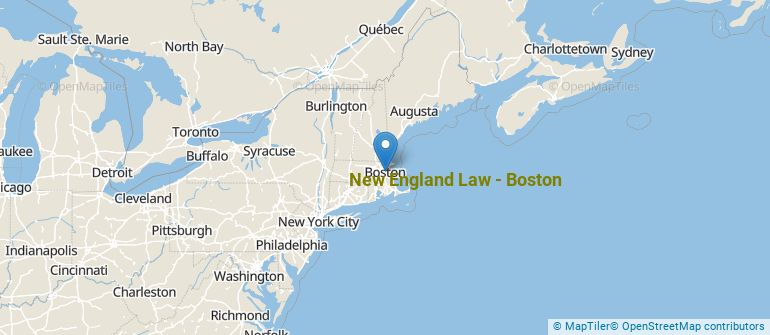
New England Law - Boston is a private not-for-profit institution situated in Boston, Massachusetts. The location of New England Law is great for students who prefer living in an urban area.

Get more details about the location of New England Law - Boston.
undefined

Contact details for New England Law are given below.

Contact Details
Address:154 Stuart Street, Boston, MA 02116
Phone:617-451-0010
Website:www.nesl.edu/

New England Law - Boston Majors

1 Majors With Completions
566 Undergraduate Degrees
566 Graduate Degrees
During the most recent year for which we have data, students from 1 majors graduated from New England Law - Boston. Of these students, 566 received undergraduate degrees and 566 graduated with a master's or doctor's degree. The following table lists the most popular undergraduate majors along with the average salary graduates from those majors make.

Most Popular MajorsBachelor’s DegreesAverage Salary of Graduates
Law283NA

Learn more about the majors offered at New England Law - Boston along with which ones have the highest average starting salaries.

Online Learning at New England Law

18% Take At Least One Class Online

Online learning options are becoming more and more popular at American colleges and universities. Online classes are great for students who have busy schedules or for those who just want to study on their own time.

In 2022-2023, 189 students took at least one online class at New England Law - Boston. This is a decrease from the 384 students who took online classes the previous year.

YearTook at Least One Online ClassTook All Classes Online
2022-20231890
2021-20223841
2020-2021902423
2018-201900

Learn more about online learning at New England Law - Boston.

Notes and References

Footnotes

*The racial-ethnic minorities count is calculated by taking the total number of students and subtracting white students, international students, and students whose race/ethnicity was unknown. This number is then divided by the total number of students at the school to obtain the racial-ethnic minorities percentage.

References

More about our data sources and methodologies.

Popular Reports

College Rankings
Best by Location
Degree Guides by Major
Graduate Programs

Compare Your School Options