 by our College Data Analytics Team
College Factual analyzes over 2,000 colleges and universities in its annual rankings and ranks them in a variety of ways, including most diverse, best overall quality, best for non-traditional students, and much more.
South University, Columbia was awarded 2 badges in the 2025 rankings. The highest ranked major at the school is health professions.
Explore the best ranked schools for the programs you are most interested in.
According to College Factual's 2025 analysis, South University, Columbia is ranked #1,689 out of 2,152 schools in the nation that were analyzed for overall quality. This is an improvement over the previous year, when South University, Columbia held the #2,120 spot on the Best Overall Colleges list.
South University, Columbia is also ranked #31 out of 45 schools in South Carolina.
Returning adults and other non-traditional students may appreciate the fact that South University, Columbia has an open admissions policy. This means that you'll only have to submit basic materials, which may include proof that you completed high school or an equivalent program.
The student to faculty ratio is often used to estimate how much interaction there is between professors and their students at a college or university. At South University, Columbia, this ratio is 15 to 1, which is on par with the national average of 15 to 1. That's not bad at all.
Another measure that is often used to estimate how much access students will have to their professors is how many faculty members are full-time. The idea here is that part-time faculty tend to spend less time on campus, so they may not be as available to students as full-timers.
The full-time faculty percentage at South University, Columbia is 21%. This is lower than the national average of 47%.
The freshmen retention rate is a measure of what percentage of first-year, full-time students come back for their sophomore year. The 46% rate at South University, Columbia is a good bit lower than the national rate of 68%. This could be for a number of reasons, such as students transferring after a year because they changed majors.
The on-time graduation rate is the percent of first-time, full time students who obtain their bachelor's degree in four years or less. This rate is 8% for first-time, full-time students at South University, Columbia, which is lower than the national rate of 33.3%.
Find out more about the retention and graduation rates at South University, Columbia.
During the 2017-2018 academic year, there were 518 undergraduates at South University, Columbia with 349 being full-time and 169 being part-time.
The net price is calculated by adding tuition, room, board and other costs and subtracting financial aid.Note that the net price is typically less than the published for a school. For more information on the sticker price of South University, Columbia, see our tuition and fees and room and board pages.
It's not uncommon for college students to take out loans to pay for school. In fact, almost 66% of students nationwide depend at least partially on loans. At South University, Columbia, approximately 80% of students took out student loans averaging $8,125 a year. That adds up to $32,500 over four years for those students.
Get more details about paying for South University, Columbia.
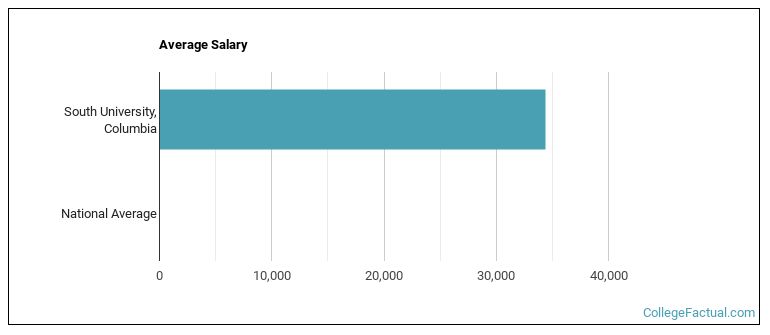
See which majors at South University, Columbia make the most money.
Get more details about the location of South University, Columbia.
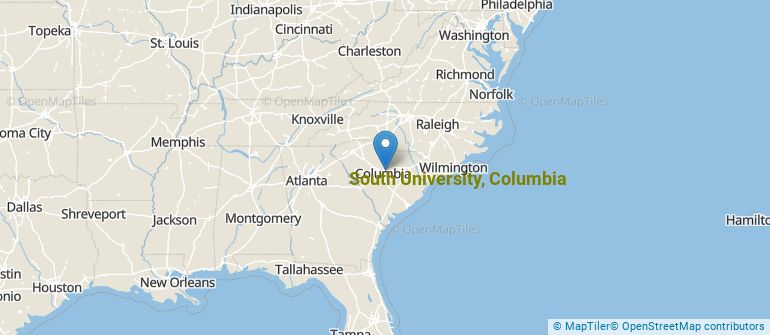
Contact details for South University, Columbia are given below.
| Contact Details | |
|---|---|
| Address: | 9 Science Court, Columbia, SC 29203 |
| Phone: | 803-799-9082 |
| Website: | www.southuniversity.edu/columbia#location=Columbia, SC |
| Most Popular Majors | Bachelor’s Degrees | Average Salary of Graduates |
|---|---|---|
| Allied Health & Medical Assisting Services | 29 | NA |
| Nursing | 25 | $77,635 |
| Mental & Social Health Services | 19 | NA |
| Business Administration & Management | 16 | $43,773 |
| Health & Medical Administrative Services | 16 | $39,722 |
| Public Health | 15 | $34,789 |
| Pharmacy/Pharmaceutical Sciences | 9 | NA |
| Criminal Justice & Corrections | 8 | $37,713 |
| General Psychology | 7 | $28,684 |
| Public Administration | 4 | NA |
Online learning is becoming popular at even the oldest colleges and universities in the United States. Not only are online classes great for returning adults with busy schedules, they are also frequented by a growing number of traditional students.
In 2022-2023, 301 students took at least one online class at South University, Columbia. This is an increase from the 295 students who took online classes the previous year.
| Year | Took at Least One Online Class | Took All Classes Online |
|---|---|---|
| 2022-2023 | 301 | 194 |
| 2021-2022 | 295 | 165 |
| 2020-2021 | 339 | 215 |
| 2018-2019 | 469 | 0 |
Learn more about online learning at South University, Columbia.
Footnotes
*The racial-ethnic minorities count is calculated by taking the total number of students and subtracting white students, international students, and students whose race/ethnicity was unknown. This number is then divided by the total number of students at the school to obtain the racial-ethnic minorities percentage.
References
More about our data sources and methodologies.