College Factual  by our College Data Analytics Team
       Unbiased Factual Guarantee

St Lukes Hospital School of Nursing Data & Information Overview

If you want to know more about St Lukes Hospital School of Nursing, such as what majors does it offer, how diverse it is, how well it ranks, and more, this is your one-stop resource. If you’re interested in learning more about a particular stat, just click on its tile to go to a new page that covers the topic more in-depth. Also, you can jump to any section of this page by clicking one of the links below.

How Well Is St Lukes Hospital School of Nursing Ranked?

2025 Rankings

Explore Best Ranked Schools for You

Explore the best ranked schools for the programs you are most interested in.

Overall Quality

St Lukes Hospital School of Nursing was not ranked in College Factual's 2025 Best Overall Colleges report. This could be for a number of reasons, including lack of data.

See all of the rankings for St Lukes Hospital School of Nursing.

Is It Hard to Get Into St Lukes Hospital School of Nursing?

Learn more about St Lukes Hospital School of Nursing admissions.

St Lukes Hospital School of Nursing Faculty

10 to 1 Student to Faculty

Student to Faculty Ratio

At St Lukes Hospital School of Nursing, the student to faculty ratio is an excellent 10 to 1. That's much better than the national average of 15 to 1. This indicates that many classes will probably be small, and students will have ample opportunites to work closely with their professors and classmates.

Retention and Graduation Rates at St Lukes Hospital School of Nursing

Find out more about the retention and graduation rates at St Lukes Hospital School of Nursing.

St Lukes Hospital School of Nursing Undergraduate Student Diversity

228 Full-Time Undergraduates
24.6% Racial-Ethnic Minorities*
93.4% Percent Women

During the 2017-2018 academic year, there were 228 full-time undergraduates at St Lukes Hospital School of Nursing.
How Much Does St Lukes Hospital School of Nursing Cost?

Get more details about paying for St Lukes Hospital School of Nursing.

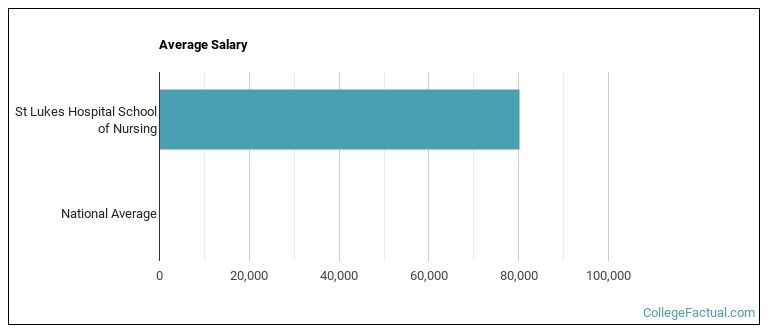
How Much Money Do St Lukes Hospital School of Nursing Graduates Make?

$80,244 Avg Salary of Grads
High Earnings Boost
Although some majors pay more than others, students who graduate from St Lukes Hospital School of Nursing with a bachelor's degree go on to jobs where they make an average salary of $80,244 in their early years. This is good news for future St Lukes Hospital School of Nursing graduates since it is 63% more than the average college graduate's salary of $49,219 per year.

undefined

See which majors at St Lukes Hospital School of Nursing make the most money.

Location of St Lukes Hospital School of Nursing

Pennsylvania State
228 Full-Time Undergraduates
Suburb Campus Setting
St Lukes Hospital School of Nursing is a private not-for-profit institution situated in Bethlehem, Pennsylvania. Bethlehem is considered a suburb and offers tranquility and safety near the excitement of a city center.

Get more details about the location of St Lukes Hospital School of Nursing.

undefined

Contact details for St Lukes Hospital School of Nursing are given below.

Contact Details
Address:801 Ostrum Street, Bethlehem, PA 18015
Phone:484-526-3401
Website:https://www.slhn.org/bethlehem

St Lukes Hospital School of Nursing Majors

1 Majors With Completions
282 Undergraduate Degrees
282 Graduate Degrees
During the most recent year for which we have data, students from 1 majors graduated from St Lukes Hospital School of Nursing. Of these students, 282 received undergraduate degrees and 282 graduated with a master's or doctor's degree. The following table lists the most popular undergraduate majors along with the average salary graduates from those majors make.

Most Popular MajorsBachelor’s DegreesAverage Salary of Graduates
Nursing141NA

Learn more about the majors offered at St Lukes Hospital School of Nursing along with which ones have the highest average starting salaries.

Learn more about online learning at St Lukes Hospital School of Nursing.

Notes and References

Footnotes

*The racial-ethnic minorities count is calculated by taking the total number of students and subtracting white students, international students, and students whose race/ethnicity was unknown. This number is then divided by the total number of students at the school to obtain the racial-ethnic minorities percentage.

References

More about our data sources and methodologies.

Popular Reports

College Rankings
Best by Location
Degree Guides by Major
Graduate Programs

Compare Your School Options