College Factual  by our College Data Analytics Team
       Unbiased Factual Guarantee

Texas College of Cosmetology-San Angelo Data & Information Overview

This overview covers the essential stats on Texas College of Cosmetology-San Angelo, including its rankings, majors, diversity, and more. All you need to do to learn more about a stat is click on its tile, and you’ll be taken to another page that analyzes that data more closely. Also, you can use the links below to scroll to any section of this page.

How Well Is Texas College of Cosmetology-San Angelo Ranked?

2025 Rankings

Explore Best Ranked Schools for You

Explore the best ranked schools for the programs you are most interested in.

Overall Quality

Texas College of Cosmetology-San Angelo was not ranked in College Factual's Best Overall Colleges report this year. This may be because not enough data was available.

See all of the rankings for Texas College of Cosmetology-San Angelo.

Is It Hard to Get Into Texas College of Cosmetology-San Angelo?

Open Admissions Policy

Acceptance Rate

If you are worried about getting into Texas College of Cosmetology-San Angelo, don't be. The school has a liberal open admissions policy, which means you only need to meet basic requirements in order to be admitted. Still, be sure to submit a complete application and provide any other requested materials.

Learn more about Texas College of Cosmetology-San Angelo admissions.

Texas College of Cosmetology-San Angelo Faculty

10 to 1 Student to Faculty

Student to Faculty Ratio

The student to faculty ratio is often used to measure the number of teaching resources that a college or university offers its students. The national average for this metric is 15 to 1, but at Texas College of Cosmetology-San Angelo it is much better at 10 to 1. That's good news for students who want to interact more on a personal level with their teachers.

Retention and Graduation Rates at Texas College of Cosmetology-San Angelo

73% Freshmen Retention

Freshmen Retention Rate

Texas College of Cosmetology-San Angelo has a freshmen retention rate of 73%. That's a good sign that full-time students like the school and their professors enough to want to stick around for another year. It's also a sign that the admissions team did a good job in choosing applicants who were a good fit for the school.

Freshmen Retention Rate  73 out of 100
0
100

Find out more about the retention and graduation rates at Texas College of Cosmetology-San Angelo.

Texas College of Cosmetology-San Angelo Undergraduate Student Diversity

79 Full-Time Undergraduates
62.0% Racial-Ethnic Minorities*
93.7% Percent Women

During the 2017-2018 academic year, there were 79 full-time undergraduates at Texas College of Cosmetology-San Angelo.

How Much Does Texas College of Cosmetology-San Angelo Cost?

$16,355 Net Price
66% Take Out Loans
$20,700 Total Student Loans
The overall average net price of Texas College of Cosmetology-San Angelo is $16,355. The affordability of the school largely depends on your financial need since net price varies by income group.

The net price is calculated by adding tuition, room, board and other costs and subtracting financial aid.Note that the net price is typically less than the published for a school. For more information on the sticker price of Texas College of Cosmetology-San Angelo, see our tuition and fees and room and board pages.

Student Loan Debt

While almost two-thirds of students nationwide take out loans to pay for college, the percentage may be quite different for the school you plan on attending. At Texas College of Cosmetology-San Angelo, approximately 66% of students took out student loans averaging $5,175 a year. That adds up to $20,700 over four years for those students.

Get more details about paying for Texas College of Cosmetology-San Angelo.
How Much Money Do Texas College of Cosmetology-San Angelo Graduates Make?

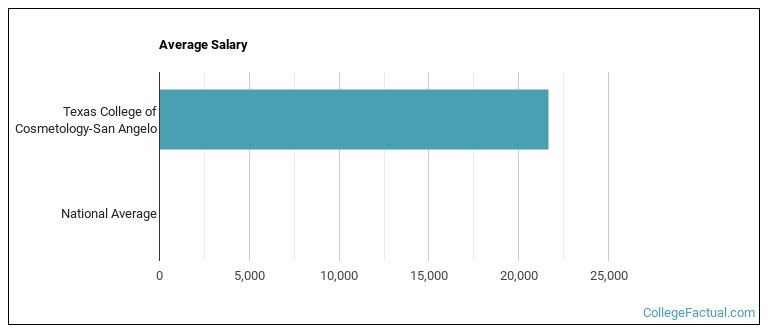
$21,685 Avg Salary of Grads
High Earnings Boost
The pay for some majors is higher than others, but on average, students who graduate with a bachelor's degree from Texas College of Cosmetology-San Angelo make about $21,685 a year during their first few years of employment after graduation. This is about 56% less that the average pay for college graduates overall. However, graduates with your major may make more.

undefined

See which majors at Texas College of Cosmetology-San Angelo make the most money.

Location of Texas College of Cosmetology-San Angelo

Texas State
79 Full-Time Undergraduates
Small City Campus Setting
Texas College of Cosmetology-San Angelo is a private for-profit institution situated in San Angelo, Texas. The city atmosphere of San Angelo makes it a great place for students who enjoy having lots of educational and entertainment options.

Get more details about the location of Texas College of Cosmetology-San Angelo.

undefined

Contact details for Texas College of Cosmetology-San Angelo are given below.

Contact Details
Address:3504 Knickerbocker Road, San Angelo, TX 76904
Phone:325-659-2622
Website:www.texascollegecosmetology.com/

Texas College of Cosmetology-San Angelo Majors

1 Majors With Completions
150 Undergraduate Degrees
150 Graduate Degrees
During the most recent year for which we have data, students from 1 majors graduated from Texas College of Cosmetology-San Angelo. Of these students, 150 received undergraduate degrees and 150 graduated with a master's or doctor's degree. The following table lists the most popular undergraduate majors along with the average salary graduates from those majors make.

Most Popular MajorsBachelor’s DegreesAverage Salary of Graduates
Cosmetology75NA

Learn more about the majors offered at Texas College of Cosmetology-San Angelo along with which ones have the highest average starting salaries.

Learn more about online learning at Texas College of Cosmetology-San Angelo.

Notes and References

Footnotes

*The racial-ethnic minorities count is calculated by taking the total number of students and subtracting white students, international students, and students whose race/ethnicity was unknown. This number is then divided by the total number of students at the school to obtain the racial-ethnic minorities percentage.

References

More about our data sources and methodologies.

Popular Reports

College Rankings
Best by Location
Degree Guides by Major
Graduate Programs

Compare Your School Options