 by our College Data Analytics Team
Below are the key facts about this program at University of Oklahoma-Health Sciences Center. It is offered at the Bachelor’s level, with graduate study also available. It ranks as high as #1 out of 1 schools (Bachelor’s level) by College Factual. Jump to any of the following sections:
College Factual rates University of Oklahoma-Health Sciences Center highly for allied health professions, coming in at #30 out of 1,080 schools nationally.
| Ranking | Rank |
|---|---|
| Best Allied Health Professions Schools | 30 of 1,080 |
| Best Allied Health Professions Schools in Oklahoma | 1 of 12 |
| Best Allied Health Professions Schools in the Southwest Region | 3 of 112 |
The table below lists every degree level available for allied health professions at University of Oklahoma-Health Sciences Center, along with how many graduates complete each level annually.
| Degree Level | Annual Graduates |
|---|---|
| Bachelor’s | 53 |
| Master’s | 73 |
In the most recent year for which we have data, University of Oklahoma-Health Sciences Center conferred 53 bachelor’s degrees in allied health professions.
University of Oklahoma-Health Sciences Center is among the very best schools in the country for allied health professions at the bachelor’s level. In particular it placed #1 out of 1 schools by College Factual.
Allied Health Professions graduates with a bachelor’s degree from University of Oklahoma-Health Sciences Center go on to jobs where they make a median salary of $66,675 a year. This is lower than $87,122, the median for all majors at University of Oklahoma-Health Sciences Center.
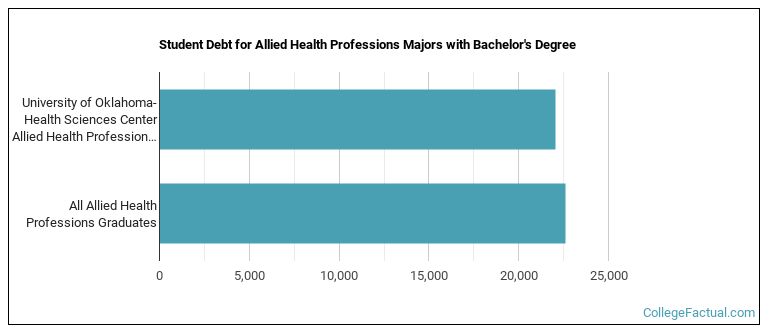
While getting their bachelor’s degree at University of Oklahoma-Health Sciences Center, allied health professions graduates take on a median debt of $22,062 in student loans. This is below $22,613, the typical median for all majors at University of Oklahoma-Health Sciences Center.
Information about average full-time undergraduate tuition and fees is shown in the table below.
| In State | Out of State | |
|---|---|---|
| Tuition | $7,925 | $23,328 |
| Fees | $2,386 | $2,386 |
Read more about University of Oklahoma-Health Sciences Center tuition and fees.
Among recent graduates, 25% of allied health professions bachelor’s degrees went to men and 75% went to women.
 The majority of allied health professions bachelor’s degree graduates at University of Oklahoma-Health Sciences Center were White. Approximately 66% of graduates fell into this category.
The following table and chart show the ethnic background for students who recently graduated from University of Oklahoma-Health Sciences Center with a bachelor’s in allied health professions.

| Ethnic Background | Number of Students |
|---|---|
| Asian | 4 |
| Black or African American | 0 |
| Hispanic or Latino | 7 |
| White | 35 |
| Non-Resident Aliens | 0 |
| Other Races | 7 |
University of Oklahoma-Health Sciences Center conferred 17 bachelor’s completions in diagnostic medical sonography/sonographer and ultrasound technician in the latest year of data — 100% to women and 0% to men. The most common background among these graduates was White (71%).
University of Oklahoma-Health Sciences Center awarded 17 bachelor’s completions in medical radiologic technology/science - radiation therapist recently — 65% to women and 35% to men. Most of these graduates identified as White (65%).
University of Oklahoma-Health Sciences Center conferred 13 bachelor’s degrees in radiologic technology/science - radiographer in the most recent reporting year — 46% to women and 54% to men. The largest share of these graduates were White (62%).
University of Oklahoma-Health Sciences Center conferred 6 bachelor’s completions in nuclear medical technology/technologist in the most recent reporting year — 100% to women and 0% to men. The most common background among these graduates was White (67%).
Graduate study is also available at University of Oklahoma-Health Sciences Center. The following graduate award levels are reported.
| Graduate Level | Annual Graduates |
|---|---|
| Master’s Degrees in Allied Health Professions | 73 |
