 by our College Data Analytics Team
College Factual recognizes the best colleges and universities in its annual rankings. These rankings include categories for best overall colleges, best colleges for each major, best value schools, and much more.
University of Puerto Rico - Medical Sciences was awarded 18 badges in the 2025 rankings. The highest ranked major at the school is health professions.
Explore the best ranked schools for the programs you are most interested in.
UPR Medical Sciences was not ranked in College Factual's Best Overall Colleges report this year. This may be because not enough data was available.
See all of the rankings for University of Puerto Rico - Medical Sciences.
The student to faculty ratio at UPR Medical Sciences is an impressive 2 to 1. That's quite good when you compare it to the national average of 15 to 1. This is a good sign that students at the school will have more opportunities for one-on-one interactions with their professors.
In addition to the student to faculty ratio, some people look at what percentage of faculty members are full-time as a sign of how much time professors will be able to spend with their students. This is because part-time teachers may not be be on campus as much as their full-time counterparts.
The full-time faculty percentage at University of Puerto Rico - Medical Sciences is 69%. This is higher than the national average of 47%.
During the 2017-2018 academic year, there were 357 undergraduates at UPR Medical Sciences with 333 being full-time and 24 being part-time.
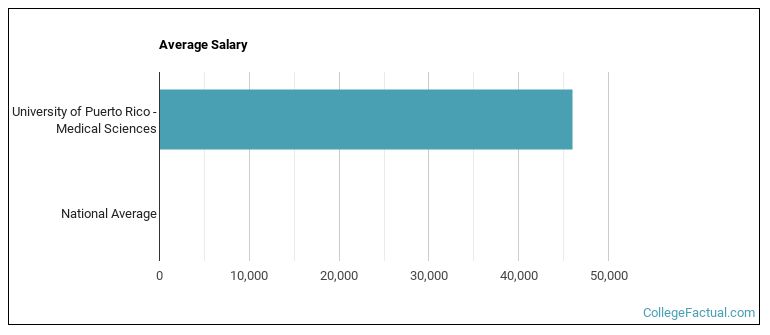
See which majors at University of Puerto Rico - Medical Sciences make the most money.
Get more details about the location of University of Puerto Rico - Medical Sciences.
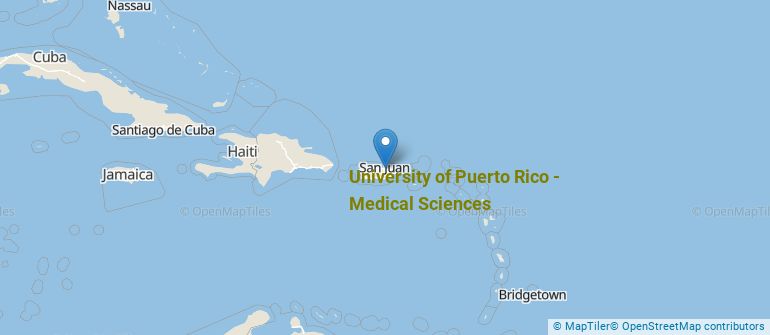
Contact details for UPR Medical Sciences are given below.
| Contact Details | |
|---|---|
| Address: | Rio Piedras Medical Center, Americo Miranda Avenue, San Juan, PR 00936-5067 |
| Phone: | 787-758-2525 |
| Website: | www.rcm.upr.edu/ |
| Most Popular Majors | Bachelor’s Degrees | Average Salary of Graduates |
|---|---|---|
| Public Health | 141 | NA |
| Nursing | 126 | $16,686 |
| Medicine | 103 | NA |
| Dentistry | 57 | NA |
| Pharmacy/Pharmaceutical Sciences | 48 | NA |
| Clinical/Medical Laboratory Science | 42 | NA |
| Rehabilitation & Therapeutic Professions | 38 | NA |
| Veterinary/Animal Health Technologies/Technicians | 28 | NA |
| Advanced Dentistry & Oral Sciences | 27 | NA |
| Gerontology | 26 | NA |
Online learning options are becoming more and more popular at American colleges and universities. Online classes are great for students who have busy schedules or for those who just want to study on their own time.
In 2022-2023, 1,415 students took at least one online class at University of Puerto Rico - Medical Sciences. This is a decrease from the 1,549 students who took online classes the previous year.
| Year | Took at Least One Online Class | Took All Classes Online |
|---|---|---|
| 2022-2023 | 1,415 | 291 |
| 2021-2022 | 1,549 | 254 |
| 2020-2021 | 2,218 | 0 |
| 2018-2019 | 666 | 0 |
Learn more about online learning at University of Puerto Rico - Medical Sciences.
Footnotes
*The racial-ethnic minorities count is calculated by taking the total number of students and subtracting white students, international students, and students whose race/ethnicity was unknown. This number is then divided by the total number of students at the school to obtain the racial-ethnic minorities percentage.
References
More about our data sources and methodologies.