 by our College Data Analytics Team
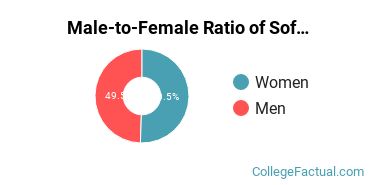
Athough the male-female ratio may vary depending on the degree program, 50.5% of the total graduate students at Institute of Transpersonal Psychology are women and 49.5% are men.
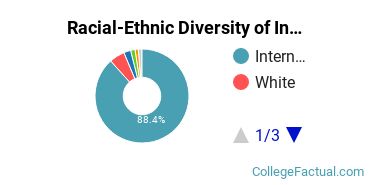
Racial-ethnic minorities* make up 4.8% of the graduate student population at Institute of Transpersonal Psychology. Institute of Transpersonal Psychology is popular with people from outside the United States, too. International students make up 88.4% of the graduate student population. The chart below shows the breakdown of graduate student demographics at the school. You can click on it for a more detailed view.
The average tuition and fees for graduate students is shown below.
| In-State | Out-of-State | |
|---|---|---|
| Tuition | $14,415 | $14,415 |
| Fees | $500 | $500 |
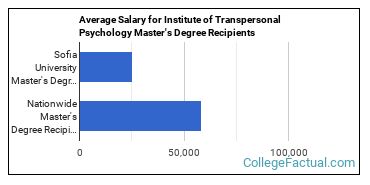
After obtaining their master's degree from Institute of Transpersonal Psychology, graduates go on to jobs earning an average starting salary of $25,120. Unfortunately for those graduates, that figure is about 57% lower than the national average of $58,425.
Get more details about the location of Sofia University.

Contact details for Institute of Transpersonal Psychology are given below.
| Contact Details | |
|---|---|
| Address: | 1069 East Meadow Cr, Palo Alto, CA 94303 |
| Phone: | 650-493-4430 |
| Website: | www.sofia.edu/ |
| Facebook: | https://www.facebook.com/MySofiaU |
| Twitter: | https://twitter.com/SofiauCA |
About 99.4% of the graduate students at Sofia University took at least one online class during the 2020-2021 academic year. Roughly 78.4% of all grad students took courses exclusively online.

The only degree programs listed here are those in which master’s degrees were awarded in 2020-2021.
| Master’s Degree Program | Annual Graduates |
|---|---|
| Business Administration & Management | 637 |
| Computer Science | 16 |
| Other Psychology | 11 |
Just like the master’s degree programs, only programs that had doctorate degrees awarded in 2020-2021 are shown here.
| Doctorate Degree Program | Annual Graduates |
|---|---|
| Clinical, Counseling & Applied Psychology | 1 |
| Other Psychology | 6 |
Footnotes
*The racial-ethnic minorities count is calculated by taking the total number of students and subtracting white students, international students, and students whose race/ethnicity was unknown. This number is then divided by the total number of students at the school to obtain the racial-ethnic minorities percentage.
References
More about our data sources and methodologies.