 by our College Data Analytics Team
Here is an overview of the graduate program in instructional media design at U of Michigan. You can earn it at the Professional Certificate level. Jump to any of the following sections:
College Factual rates U of Michigan as a strong choice for instructional media design, ranked #2 out of 149 schools nationally.
| Ranking | Rank |
|---|---|
| Best Instructional Media Design Schools | 2 of 149 |
| Best Instructional Media Design Schools in Michigan | 1 of 4 |
| Best Instructional Media Design Schools in the Great Lakes Region | 1 of 17 |
The following degree levels are granted in instructional media design at U of Michigan, along with how many graduates complete each level annually.
| Degree Level | Annual Graduates |
|---|---|
| Professional Certificate | 12 |
During the most recent reporting year, University of Michigan-Ann Arbor handed out 12 professional certificate degrees in instructional media design.
U of Michigan is not yet ranked for instructional media design at the professional certificate level.
Average full-time graduate tuition and fees are listed in the table below.
| In State | Out of State | |
|---|---|---|
| Tuition | $72,552 | $75,552 |
| Fees | $332 | $332 |
Learn more about U of Michigan tuition and fees.
For the most recent academic year available, 42% of instructional media design professional certificate degrees went to men and 58% went to women.
 The largest share of instructional media design professional certificate degree graduates at U of Michigan are Non-Resident Alien. About 67% of graduates fell into this category.
The following table and chart show the ethnic background for students who recently graduated from University of Michigan-Ann Arbor with a professional certificate in instructional media design.
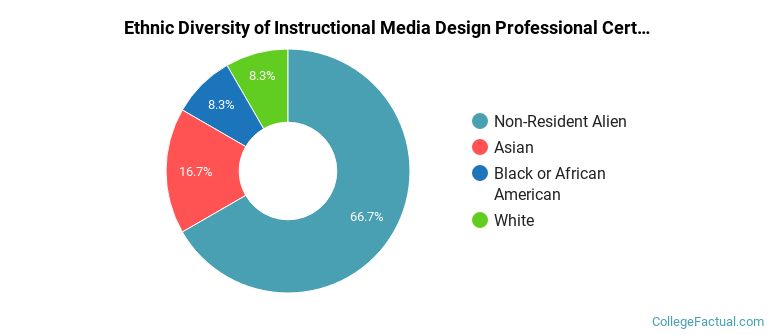
| Ethnic Background | Number of Students |
|---|---|
| Asian | 2 |
| Black or African American | 1 |
| Hispanic or Latino | 0 |
| White | 1 |
| Non-Resident Aliens | 8 |
| Other Races | 0 |
U of Michigan conferred 12 professional certificate degrees in educational/instructional technology in the latest year of data — 58% to women and 42% to men. The largest share of these graduates were Non-Resident Alien (67%).