 by our College Data Analytics Team
Below are the key facts about this program at Murray State University. Degrees are awarded at the Bachelor’s level. Jump to any of the following sections:
Here is each degree level available for radio, tv & digital communication at Murray State University, along with how many graduates complete each level annually.
| Degree Level | Annual Graduates |
|---|---|
| Bachelor’s | 10 |
For the most recent IPEDS reporting year, Murray State University handed out 10 bachelor’s degrees in radio, tv & digital communication.
Murray State University is not currently ranked for radio, tv & digital communication at the bachelor’s level.
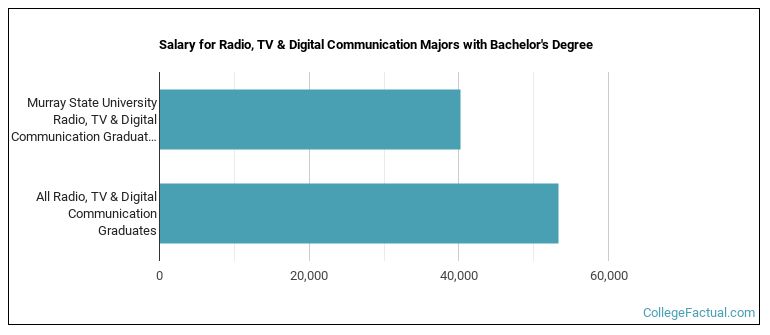
Radio, TV & Digital Communication graduates with a bachelor’s degree from Murray State University report a median salary of $40,203 a year. This is below $53,312, the median for all majors at Murray State University.
The full-time undergraduate tuition and fees are shown below.
| In State | Out of State | |
|---|---|---|
| Tuition | $8,040 | $18,540 |
| Fees | $1,296 | $1,296 |
Find out more about Murray State University tuition and fees.
In the most recent graduating class, 40% of radio, tv & digital communication bachelor’s degrees went to men and 60% went to women.
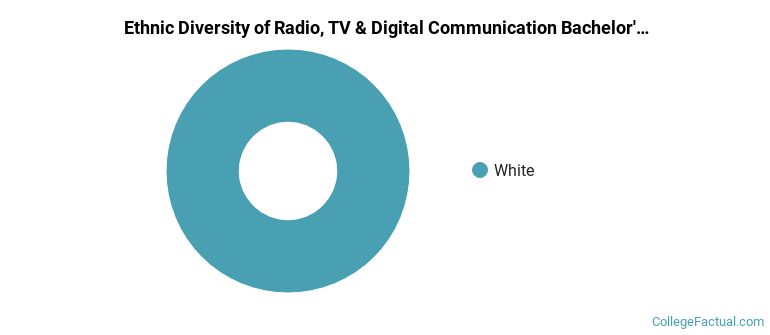
 The majority of radio, tv & digital communication bachelor’s degree graduates at Murray State University are White. Roughly 100% of graduates fell into this category.
The following table and chart show the ethnic background for students who recently graduated from Murray State University with a bachelor’s in radio, tv & digital communication.
| Ethnic Background | Number of Students |
|---|---|
| Asian | 0 |
| Black or African American | 0 |
| Hispanic or Latino | 0 |
| White | 10 |
| Non-Resident Aliens | 0 |
| Other Races | 0 |
Murray State University granted 7 bachelor’s degrees in radio and television in the most recent reporting year — 43% to women and 57% to men. The largest share of these graduates were White (100%).
Murray State University granted 3 bachelor’s completions in digital communication and media/multimedia in the most recent reporting year — 100% to women and 0% to men. The largest share of these graduates were White (100%).
More about our data sources and methodologies.