 by our College Data Analytics Team
Each year, College Factual releases its Best Quality Schools ranking to identify graduate schools that offer a great educational experience and provide excellent student outcomes. Our methodology places a high weight on things such as post-graduation wages, time to graduate, and student-per-faculty ratio. Post-graduation debt, faculty and staff diversity, and other factors are also taken into account.
DigiPen Institute of Technology came in at #1106 out of the 1149 colleges and universities that were ranked in College Factual's 2024 Best Master's Degree Schools in the U.S. ranking.
Women make up 25.4% of the total graduate student body at Digipen while men make you 74.6%. These percentages may be different for specific degree programs.

About 18.6% of the graduate students who attend Digipen are from a racial-ethnic minority group*. Americans aren't the only ones who appreciate the graduate programs at Digipen. Around 39.0% of graduate students are international. For more details on graduate school diversity at the school, check out the chart below. If you click on it, you'll be taken to a page with more details.

The average tuition and fees for graduate students is shown below.
| In-State | Out-of-State | |
|---|---|---|
| Tuition | $29,100 | $29,100 |
| Fees | $200 | $200 |
Get more details about the location of DigiPen Institute of Technology.
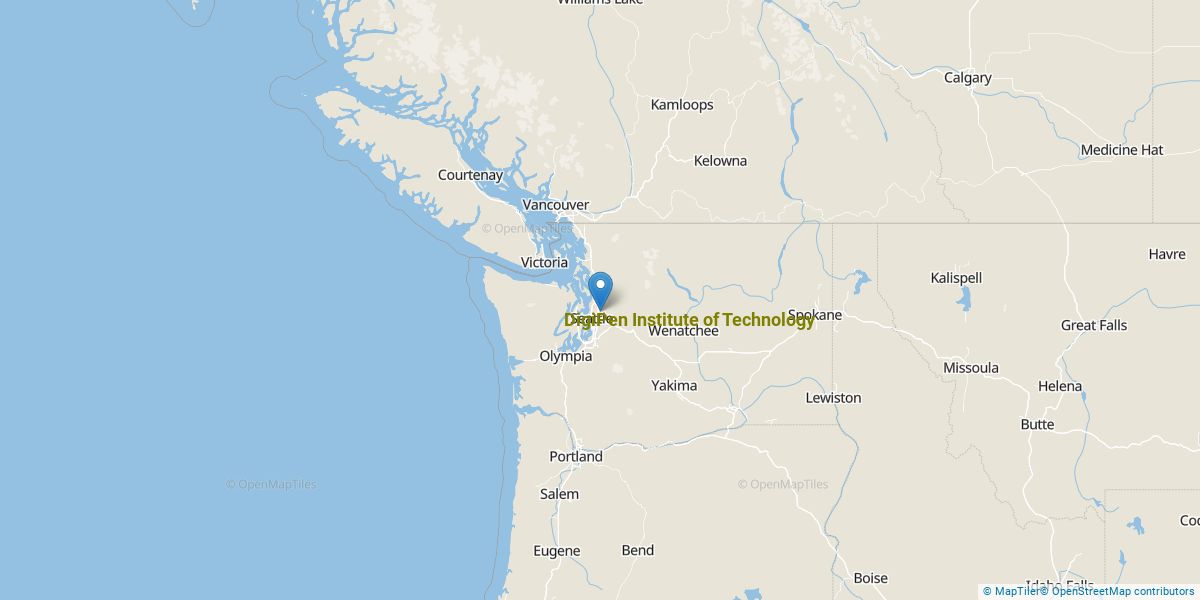
Contact details for Digipen are given below.
| Contact Details | |
|---|---|
| Address: | 9931 Willows Rd Ne, Redmond, WA 98052 |
| Phone: | 425-558-0299 |
| Website: | https://www.digipen.edu/ |
| Facebook: | https://www.facebook.com/digipen.edu |
| Twitter: | https://twitter.com/DigiPenNews |
About 72.9% of the graduate students at DigiPen Institute of Technology took at least one online class during the 2020-2021 academic year. Roughly 6.8% of all grad students took courses exclusively online.

The only degree programs listed here are those in which master’s degrees were awarded in 2020-2021.
| Master’s Degree Program | Annual Graduates |
|---|---|
| Computer Programming | 24 |
| Graphic Communications | 8 |
Footnotes
*The racial-ethnic minorities count is calculated by taking the total number of students and subtracting white students, international students, and students whose race/ethnicity was unknown. This number is then divided by the total number of students at the school to obtain the racial-ethnic minorities percentage.
References
More about our data sources and methodologies.