 by our College Data Analytics Team
The main focus area for this major is Statistics. For more details on this concentration, visit its profile page.
Statistics is a major offered under the mathematics and statistics program of study at Georgia Institute of Technology - Main Campus. We’ve pulled together some essential information you should know about the master’s degree program in stats, including how many students graduate each year, the ethnic diversity of these students, whether or not the degree is offered online, and more.
You can jump to any section of this page using the links below:
Out-of-state part-time graduates at Georgia Tech paid an average of $1,215 per credit hour in 2019-2020. The average for in-state students was $586 per credit hour. The average full-time tuition and fees for graduate students are shown in the table below.
| In State | Out of State | |
|---|---|---|
| Tuition | $14,064 | $29,140 |
| Fees | $2,194 | $2,194 |
Georgia Tech does not offer an online option for its stats master’s degree program at this time. To see if the school offers distance learning options in other areas, visit the Georgia Tech Online Learning page.
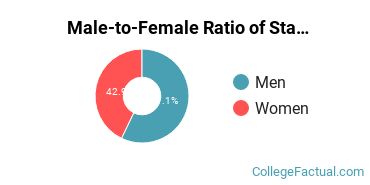
Of the students who received their master’s degree in stats in 2019-2020, 42.9% of them were women. This is less than the nationwide number of 46.7%.
Of those students who received a master’s degree at Georgia Tech in stats at 2019-2020, none were racial-ethnic minorities*.
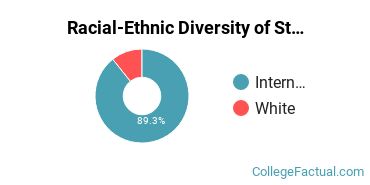
| Race/Ethnicity | Number of Students |
|---|---|
| Asian | 0 |
| Black or African American | 0 |
| Hispanic or Latino | 0 |
| Native American or Alaska Native | 0 |
| Native Hawaiian or Pacific Islander | 0 |
| White | 3 |
| International Students | 25 |
| Other Races/Ethnicities | 0 |
Statistics students may decide to major in one of the following focus areas.
| Focus Area | Annual Graduates |
|---|---|
| Statistics | 28 |
You may also be interested in one of these majors related to statistics.
| Related Major | Annual Graduates |
|---|---|
| Mathematics | 20 |
| Applied Mathematics | 61 |
*The racial-ethnic minorities count is calculated by taking the total number of students and subtracting white students, international students, and students whose race/ethnicity was unknown. This number is then divided by the total number of students at the school to obtain the racial-ethnic minorities percentage.
More about our data sources and methodologies.