by our College Data Analytics Team
Take a look at the classes and faculty information below to get a feel for student life at MMC Wilmington.
On this page you’ll find:
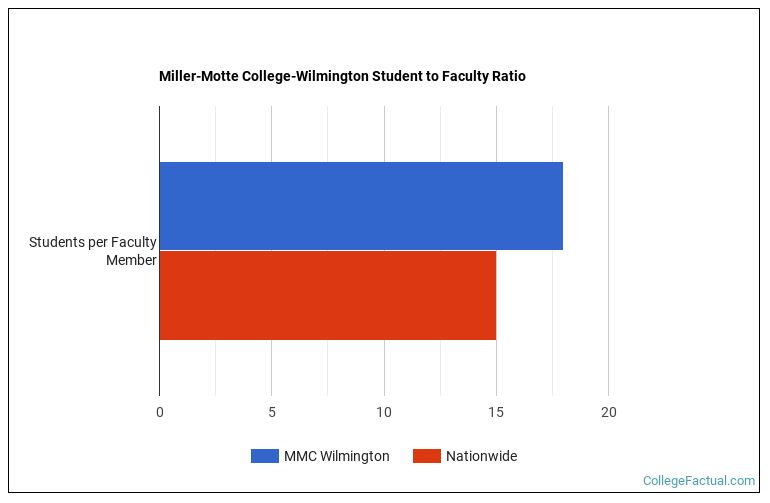
With a student to faculty ratio of 18 to 1, Miller-Motte College-Wilmington is about average in this regard, as the nationwide rate is 15 to 1.
The following table shows all the employees the school considers instructional, and therefore, part of the above student-to-faculty ratio. These include both those employees designated as either “primarily instructional” or as “instructional combined with research/public service”. It does not include employees that have been identified by Miller-Motte College-Wilmington as primarily performing research or public service.
| Total | Full Time | Part Time | Percent Full Time | |
|---|---|---|---|---|
| Total of Instructional Employees | 32 | 2 | 30 | 6% |
| Total of Those With Faculty Status | - | - | - | - |
| Tenured Faculty | - | - | - | - |
| On Tenure Track | - | - | - | - |
| Not on Tenure Track | - | - | - | - |
| Without Faculty Status | - | - | - | - |
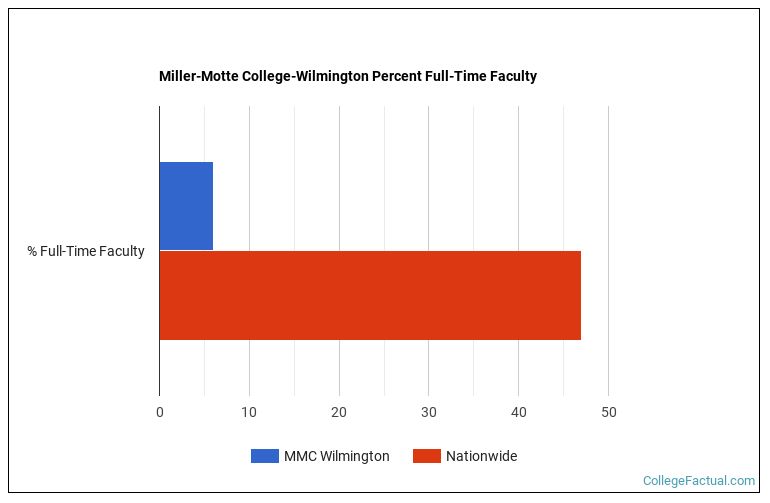
At Miller-Motte College-Wilmington, 6% of instructors are full time — lower than the national average of 47%.
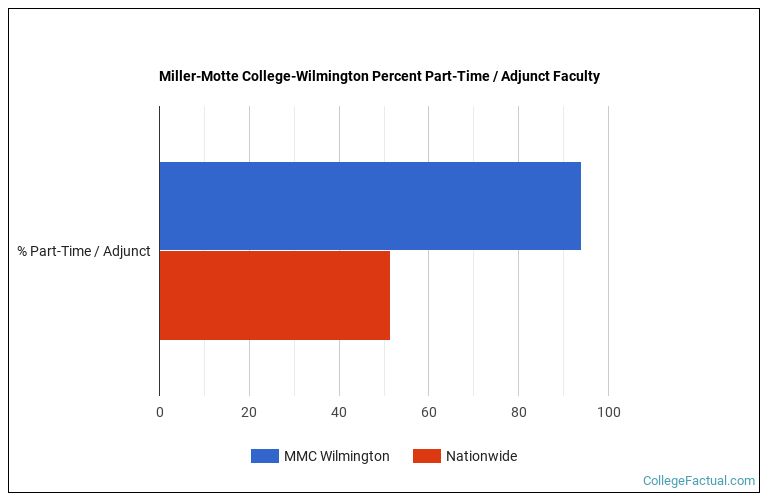
At Miller-Motte College-Wilmington, 94% of the teaching staff are part-time non-faculty or non-tenure track faculty. This is above the national average of 51.4%.
Colleges often use part-time professors and adjuncts to teach courses, rather than full-time faculty. This hiring practice is primarily a way to save money amid increasingly tight budgets. However, it is a controversial practice with strong views on either side. We encourage you to understand this topic more deeply, and how the colleges you are interested in approach faculty hiring.