 by our College Data Analytics Team
Below are the key facts about this program at NU. Degrees are awarded at the Bachelor’s level. Its best result is a rank of #2 out of 6 schools (Bachelor’s level) by College Factual. Jump to any of the following sections:
By College Factual’s measure, NU among the top schools in the country for entrepreneurial studies, placing at #87 out of 157 schools nationally.
| Ranking | Rank |
|---|---|
| Best Entrepreneurial Studies Schools | 87 of 157 |
| Best Entrepreneurial Studies Schools in Michigan | 2 of 8 |
| Best Entrepreneurial Studies Schools in the Great Lakes Region | 16 of 29 |
The following degree levels are granted in entrepreneurial studies at NU, along with how many graduates complete each level annually.
| Degree Level | Annual Graduates |
|---|---|
| Bachelor’s | 12 |
In the most recent year for which we have data, Northwood University conferred 12 bachelor’s degrees in entrepreneurial studies.
NU ranks competitively among schools offering entrepreneurial studies at the bachelor’s level. In particular it placed #2 out of 6 schools by College Factual.
Average full-time tuition and fees are listed in the table below.
| In State | Out of State | |
|---|---|---|
| Tuition | $29,000 | $32,800 |
| Fees | $1,600 | $1,600 |
Read more about NU tuition and fees.
In the most recent graduating class, 67% of entrepreneurial studies bachelor’s degrees went to men and 33% went to women.
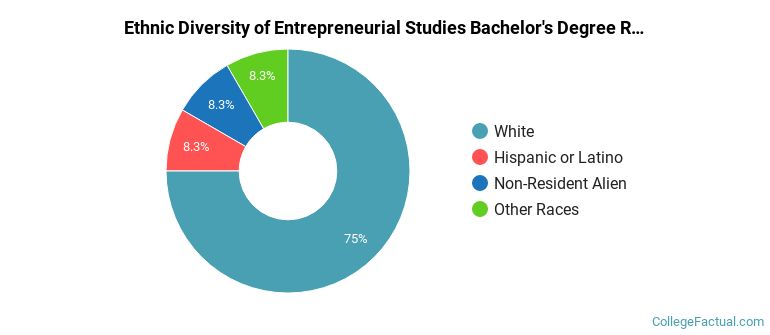
 The majority of entrepreneurial studies bachelor’s degree graduates at NU were White. Approximately 75% of graduates fell into this category.
The following table and chart show the ethnic background for students who recently graduated from Northwood University with a bachelor’s in entrepreneurial studies.
| Ethnic Background | Number of Students |
|---|---|
| Asian | 0 |
| Black or African American | 0 |
| Hispanic or Latino | 1 |
| White | 9 |
| Non-Resident Aliens | 1 |
| Other Races | 1 |
NU granted 12 bachelor’s completions in entrepreneurship/entrepreneurial studies in the most recent reporting year — 33% to women and 67% to men. The largest share of these graduates were White (75%).
More about our data sources and methodologies.