 by our College Data Analytics Team
Women make up 76.4% of the total graduate student body at Rush University while men make you 23.6%. These percentages may be different for specific degree programs.

Of all the graduate students at Rush University, around 29.0% belong to a racial-ethnic minority group. The school attracts students from outside the U.S., too. Around 0.8% of graduate students hail from another country. For more details on graduate school diversity at the school, check out the chart below. If you click on it, you'll be taken to a page with more details.

The average graduate full-time tuition and fees is shown in the table below.
| In-State | Out-of-State | |
|---|---|---|
| Tuition | $37,253 | $37,253 |
After obtaining their master's degree from Rush University, graduates go on to jobs earning an average starting salary of $66,151. That's pretty good comparatively. In fact, it is 13% higher than the national average of $58,425.

The average early-career salary for doctorate degree recipients from Rush University is $83,139. That's about 10% higher than the countrywide average of $75,260 for all doctorate degree holders.

Get more details about the location of Rush University.
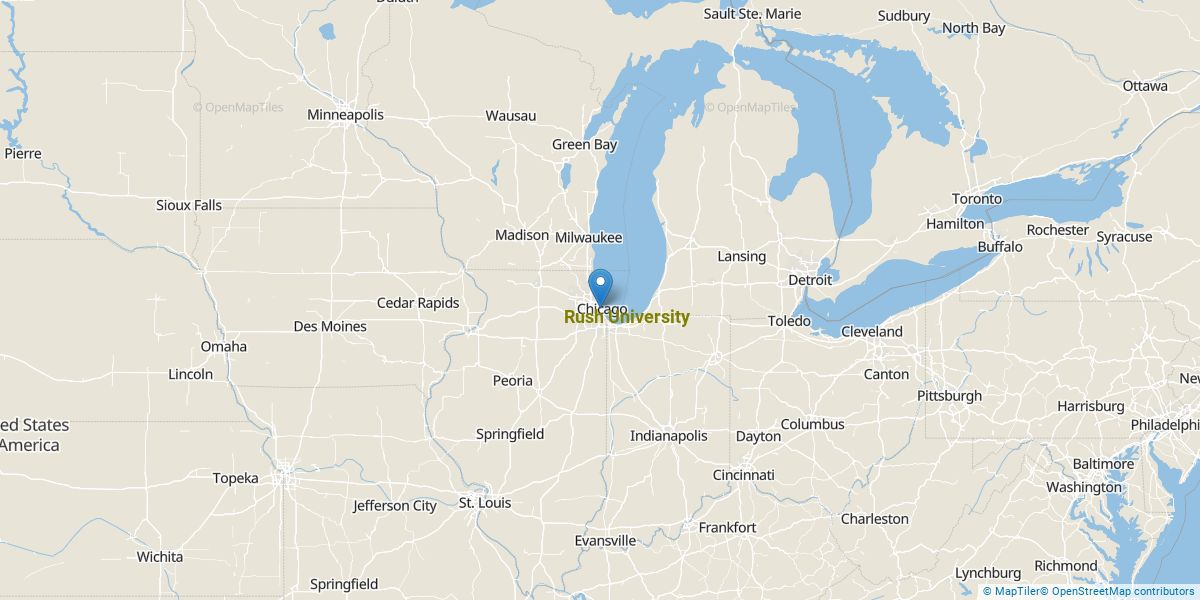
Contact details for Rush University are given below.
| Contact Details | |
|---|---|
| Address: | 600 S. Paulina St. Ste 440, Chicago, IL 60612 |
| Phone: | 312-942-7100 |
| Website: | www.rushu.rush.edu/ |
About 64.9% of the graduate students at Rush University took at least one online class during the 2020-2021 academic year. Roughly 32.0% of all grad students took courses exclusively online.

The only degree programs listed here are those in which master’s degrees were awarded in 2020-2021.
| Master’s Degree Program | Annual Graduates |
|---|---|
| Allied Health Professions | 55 |
| Biological & Biomedical Sciences (Other) | 5 |
| Biotechnology | 24 |
| Clinical/Medical Laboratory Science | 16 |
| Communication Sciences | 37 |
| Health & Medical Administrative Services | 40 |
| Medical Science | 20 |
| Nursing | 175 |
| Nutrition Science | 14 |
Just like the master’s degree programs, only programs that had doctorate degrees awarded in 2020-2021 are shown here.
Footnotes
*The racial-ethnic minorities count is calculated by taking the total number of students and subtracting white students, international students, and students whose race/ethnicity was unknown. This number is then divided by the total number of students at the school to obtain the racial-ethnic minorities percentage.
References
More about our data sources and methodologies.